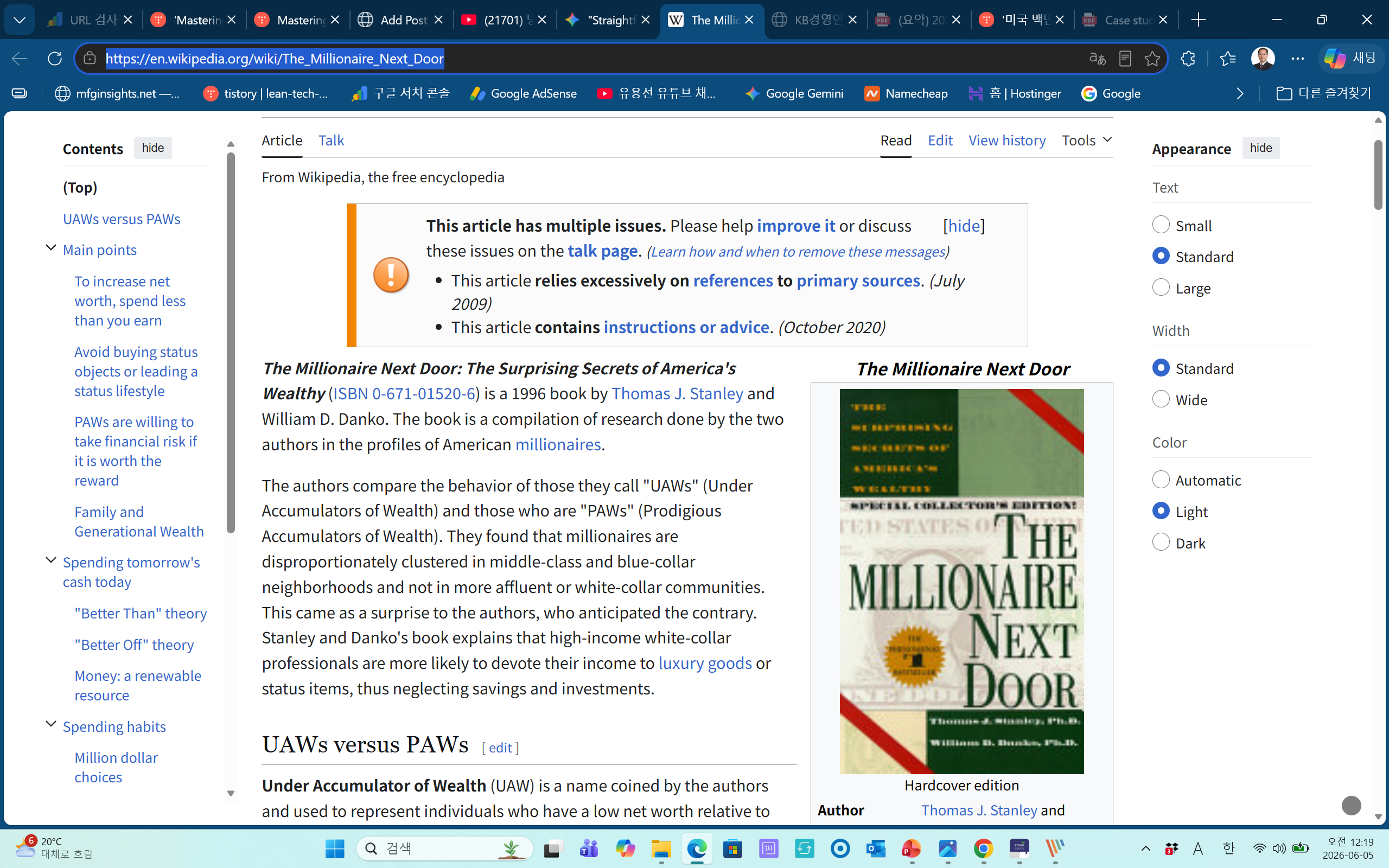
We often fall into the trap of defining wealth through the lens of glamorous lifestyles, luxury assets, and individuals who seem tailor-made for high-end magazines or reality TV shows. However, groundbreaking empirical research reveals a starkly different reality. True wealth is rarely loud; in fact, it is often extraordinarily quiet.
According to the seminal research conducted by Thomas J. Stanley and William D. Danko, the vast majority of self-made millionaires live right next door, blending seamlessly into average middle-class neighborhoods. They actively avoid putting their net worth on display. These genuine high-net-worth individuals deeply understand the true value of money, maintain lifestyles well below their actual financial means, and exercise meticulous budgetary control to achieve and sustain absolute economic independence.
For anyone aiming for successful wealth accumulation and true financial freedom, we have synthesized and detailed the 7 core strategies routinely practiced by self-made millionaires.
💡 Editor's Note: The insights and behavioral metrics analyzed below are drawn from the classic wealth accumulation study published in the renowned book, The Millionaire Next Door.
1. Active Defense: Meticulous Budgetary Planning and Control Systems
Building significant wealth requires a balanced approach: aggressive wealth generation (offense) must be paired with disciplined expenditure control (defense). Without a strong defensive strategy, high earnings quickly disappear through lifestyle inflation.

Comprehensive Monitoring: Most self-made millionaires consistently track, categorize, and monitor their total household expenditures without exception.
- Proactive Budgeting: They do not view budgeting as a restrictive or passive chore. Instead, they write out detailed financial plans as an active defensive shield to protect their growing net worth.
- The 15% Investment Rule: As a foundational baseline, these individuals systematically allocate at least 15% of their gross annual household income toward investment vehicles—such as equities, government bonds, and index funds—before budgeting for any secondary household expenses.
- Predictive Cost Control: By logging daily costs for food, clothing, and housing, they can accurately project future financial needs and eliminate unnecessary expenses.
- Long-Term Satisfaction: While under-accumulators often accumulate high-interest debt by spending tomorrow's estimated earnings today, true millionaires find far greater satisfaction in living frugally and achieving long-term economic autonomy.
2. Tax Optimization and Selecting Unpretentious Neighborhoods
Taxes represent one of the single largest continuous drains on annual household wealth. Self-made millionaires design their financial lives to legally minimize this ongoing friction.
- Minimizing Realized Income: Millionaires deliberately structure their asset portfolios to minimize realized annual income while maximizing unrealized capital appreciation.
- The 7% Realization Target: On average, these disciplined investors realize only about 7% of their total net worth as taxable income each year, which keeps their capital gains and income tax liabilities to an absolute minimum.
- The High-Consumption Trap: In sharp contrast, asset-poor, high-consumption households routinely realize up to 90% of their net worth as taxable income each year, sacrificing a massive portion of their wealth to high tax brackets.
- Strategic Modesty in Housing: Approximately 50% of millionaires choose not to live in ultra-luxury, high-prestige neighborhoods. Opting for established, middle-class communities insulates them from competitive social spending pressures and makes it much easier to quietly compound their wealth over time.
3. Allocating Disproportionate Time to Financial Planning
How you allocate your time, energy, and mental focus directly influences your long-term net worth. Millionaires treat financial planning as a high-priority job.
- Double the Planning Time: Statistically, successful wealth accumulators spend more than twice as many hours each month active planning, analyzing, and managing their investment portfolios compared to average earners.
- Focus on Core Expertise: They focus their capital on market sectors where they possess deep personal or professional knowledge. They also attend investment seminars to find high-quality assets and connect with vetted, competent financial advisors.
- The Advanced Degree Inversion: Interestingly, data shows a clear inverse relationship between advanced academic degrees and efficient wealth accumulation.
- The Social Cost of Professional Prestige: Highly educated, high-earning professionals (such as physicians and attorneys) face intense social pressure to maintain an expensive, elite lifestyle. This high consumption rate severely limits their ability to save and invest. For instance, data indicates that among doctors earning four times the national average, under-accumulators outnumber successful wealth accumulators by a ratio of two to one.
4. Prioritizing Practical Utility Over Visible Luxury
In the American West, there is a popular phrase used to describe flashy individuals who lack real financial substance: "Big hat, no cattle." Self-made millionaires are the exact opposite—they have the cattle but choose not to wear a oversized hat.
- Eliminating Prestige Shopping: While under-accumulators spend significant time browsing luxury brands and high-end goods, millionaires keep this distraction to a minimum.
- Cash Over Financing: An impressive 81% of surveyed millionaires purchase their vehicles outright with cash, avoiding high-interest auto loans or leases. Furthermore, they prefer to drive their vehicles for several years rather than upgrading frequently to chase trends.
- Reasonable Vehicle Valuations: The average purchase price for a millionaire's most recent vehicle hovers around $48,800. A clear majority (57.7%) opt for reliable domestic vehicles rather than expensive foreign imports.
- Leveraging Personal Networks: When buying a vehicle, they often use their business networks to save money, intentionally purchasing through clients who work as sales professionals (20%) or from dealerships owned by extended family members (20%).
- Assets as Business Tools: To a millionaire, a vehicle is not an expensive status symbol. It is a functional tool used to lower operational costs and maximize business efficiency.
5. Fostering Economic Independence through Intentional Parenting
Self-made millionaires understand that unconditional financial handouts can inadvertently undermine their children’s future success.
- The Subsidized Deprivation Effect: Providing adult children with continuous economic gifts—such as interest-free loans or direct down payments for luxury homes—directly reduces that child's long-term ability to build independent wealth.
- Creating Consumption Dependence: Ongoing financial support conditions adult children to rely on their parents' wealth. This expectation often leads to a lifestyle focused on high consumption rather than saving and investing.
- The Illusion of Personal Capability: Adult children who receive frequent financial gifts often confuse inherited family wealth with personal financial skill, leading to an overestimation of their own economic capabilities.
- The Gift of Non-Monetary Assets: Successful parents know that the best gifts are not cash hand-outs. Instead, they provide high-quality education, lead by example through frugal living, and offer clear incentives for personal independence.
- Character Over Currency: They consistently teach their children that money is simply a tool to achieve specific life goals, not the goal itself, while emphasizing personal integrity over material success.
6. Strategic and Highly Disciplined Estate Planning
When handling a large estate, wealth distribution requires careful planning, objective analysis, and a clear understanding of family dynamics.
- Contextual Allocation Over Equal Distribution: While some millionaires choose to split their estates equally among their children, many opt for custom, unequal distributions based on each child's unique economic situation (such as a struggling son or a daughter working as a stay-at-home parent).
- Mitigating Income Inequities: Wealthy parents often leave a larger share of the estate to daughters to offset systemic gender wage gaps. Additionally, if they do not fully trust a son-in-law, they will use legal structures like trusts to ensure family wealth cannot be accessed by a spouse.
- Preserving a Frugal Mindset: Millionaires purposely keep their exact net worth confidential from growing children. This prevents their children from adopting a high-consumption lifestyle based on an expected inheritance.
- Delayed Inheritance Windows: Estates are frequently structured to distribute inheritance when the children reach their late 30s or 40s. At this stage, their adult lives and careers are stable, ensuring the sudden wealth will not derail their personal drive.
- Preventing Family Conflict: Wise parents avoid causing family arguments by never promising specific assets before their passing. They also hire professional executors to ensure the estate is distributed smoothly and without legal errors.
7. Identifying High-Yield Professions and Emerging Markets
Millionaires possess a sharp eye for identifying where wealth is generated, and they position themselves to capture those market opportunities.
- The Power of Business Ownership: Approximately 55% of affluent households in the United States are headed by self-employed business owners or specialized professionals. Business owners are statistically 400% more likely to achieve millionaire status than traditional corporate employees.
- Steering Children Toward Specialized Professions: Interestingly, self-made parents rarely force their children to take over the family business. Instead, they encourage them to enter specialized, independent professions such as medicine, corporate law, accounting, architecture, or dentistry.
- Portable Professional Autonomy: These specialized credentials give the next generation highly portable skills that command premium fees in any economic environment.
- Capitalizing on the Affluent Service Market: As the global affluent population grows, smart entrepreneurs are targeting specialized niche markets. Huge opportunities are emerging for professionals who serve the wealthy, including estate attorneys, tax planners, high-end real estate specialists, private school operators, and immigration lawyers.
In Conclusion: The Defensive Blueprint for Financial Freedom
Ultimately, the journey to true wealth has very little to do with your initial income or the outward appearance of a luxury lifestyle. Just as a championship sports team relies on both a strong offense and an unbreakable defense to win games, your personal finances require a balanced approach: consistent income generation matched with an unshakeable defensive system for spending control.
By adopting the proven habits of self-made millionaires—carefully tracking your assets, dedicating enough time to financial planning, and prioritizing long-term financial security over short-term prestige—you can steadily move closer to your goal of lasting economic independence.